
What’s the most effective type of tutoring? What the research says
Tutoring is one of the best-evidenced ways to lift a child’s results. But the formats are not equal, and the strongest model is not the one most parents assume.

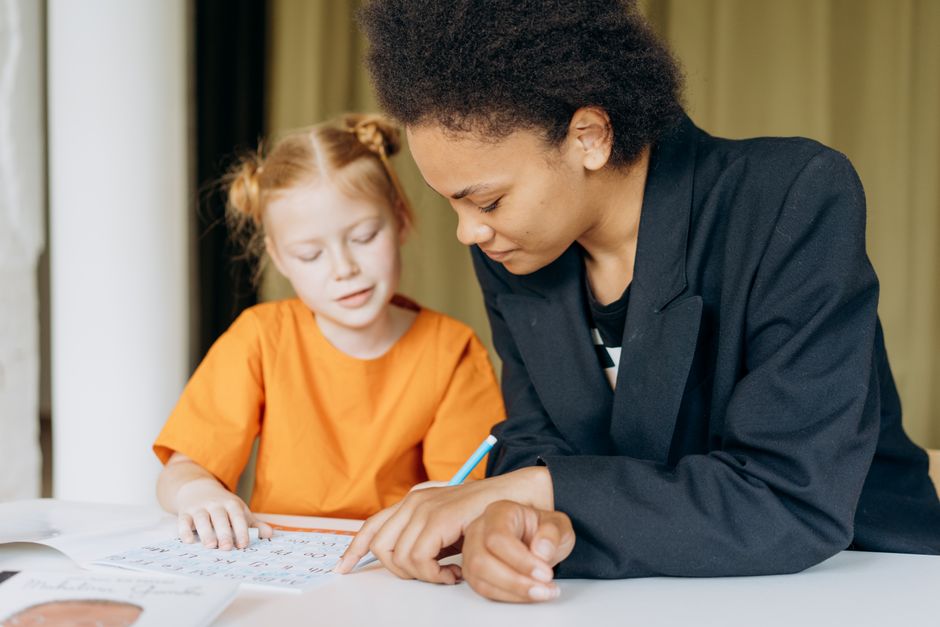
Photo: Mikhail Nilov
Once you’ve decided your child needs extra help, you face a second decision that gets far less attention: what kind of help? A private tutor at the kitchen table, a big weekend coaching class, an app with a progress bar, or a small-group centre? They can cost similar money and make similar promises, yet they work in very different ways. The good news is that researchers have been comparing them for sixty years. This article walks through what that evidence says, and how we’ve used it to shape the way Lynn’s Learning teaches.
Does tutoring actually work?
Education research is full of fads that fade under scrutiny. Tutoring is the opposite. A 2020 systematic review of 96 randomised controlled trials by economists at Northwestern and the University of Toronto found that tutoring programmes improved learning by about 0.37 standard deviations, roughly the difference between a middling result and a strong one, and the gains held across reading and maths. The Education Endowment Foundation, which grades every major education intervention by evidence strength, rates one-to-one tuition at about five months of additional progress over a year, and small-group tuition at about four.
Closer to home, the Grattan Institute reviewed the same evidence for Australian schools in 2023 and recommended small-group tuition as the single best tool for helping students catch up, worth about four months of extra learning in a year when it’s run well. So the question is not whether structured tutoring works. It’s which format squeezes the most out of it for your child.
Is one-on-one tutoring the most effective?
In 1984 the educational psychologist Benjamin Bloom published one of the most cited papers in education. Students taught one-to-one, with the teaching pitched to their level and mastery checked before moving on, performed about two standard deviations above a conventional classroom. Real-world tutoring programmes don’t reach Bloom’s laboratory numbers, as honest reviews point out, but his core finding has survived four decades of replication: children learn fastest when someone teaches them, personally, at exactly the level they’re ready for.
The average tutored student was above 98% of the students in the control class.
Benjamin Bloom, The 2 Sigma Problem, Educational Researcher (1984)
Here’s the part most parents never hear. Bloom didn’t conclude that every child should have a private tutor. He spent the rest of the paper asking how schools could get the benefits of one-to-one without the costs, because he could see the costs clearly. Later researchers filled in the detail, and it turns out the EEF’s comparison studies show mixed results: sometimes pure one-to-one wins, and sometimes tuition in groups of two or three is equally or more effective.
The over-helping problem
Learning-science researchers call it the assistance dilemma: give a child too little help and they flounder, but give too much and they stop doing the thinking that makes learning stick. A tutor who sits beside your child for a full hour sits on the wrong side of that line by default. Every hesitation gets rescued within seconds. It feels productive, and the homework looks great. But the child never has to retrieve anything from their own memory, and a growing body of research on productive struggle shows that working at something just beyond your comfort, before or between bouts of help, is where durable learning happens.
Parents tell us the pattern that follows: a child who does beautiful work with the tutor on Tuesday and freezes in the test on Friday, because the test is the first time they’ve been asked to do it alone. The scaffolding research is blunt about the fix. Support has to fade on purpose as competence grows, or the child learns to lean on it. A format where the helper never steps away can’t fade.
What about big coaching classes and apps?
Large coaching classes have real strengths: structure, discipline and plenty of independent work. But they run at one pace, and a class can only have one. Accountability stretches thin too: with one teacher to a whole room, nobody is really tracking whether your child, specifically, did the work and understood it. Maths in particular is cumulative, so a child missing one link in the chain doesn’t just find this week hard, they find every following week harder. The Grattan report cited above found the gap between struggling and strong students more than doubles between Year 3 and Year 9, and a one-pace room is part of how that happens. Meanwhile the international evidence behind Teaching at the Right Level shows the reverse move, teaching each child at their actual level rather than their year level, produces some of the most reliable gains ever measured at scale.
Apps and worksheets-by-subscription hold the opposite corner. They personalise difficulty well and cost little, and as a supplement they’re fine. What they can’t do is teach. When a concept refuses to click, an app shows the same explanation again, while your child quietly concludes they’re the problem. Nobody is there to explain it a different way, notice the slumped shoulders, or say, with evidence, that they’re doing better than they think. And nobody notices a skipped week: an app holds no one accountable, so consistency depends entirely on the child, which is usually the very thing that needs building.
Wondering where your child actually sits? A free assessment, about half an hour per subject, shows you precisely, with no cost and no obligation.
Book a free assessmentSo what does the most effective tutoring look like?
Put the findings side by side and a picture forms. From Bloom: personal teaching at the child’s level. From the assistance-dilemma and scaffolding work: help that steps in for new concepts and deliberately steps back for practice. From mastery learning, another five-month intervention in the EEF toolkit: don’t move on until this step is solid, however long that takes. From the tutoring meta-analysis: trained educators, week in, week out. And from Grattan and the EEF small-group evidence: two to five children per educator captures nearly everything one-to-one offers, while adding things it can’t. Running underneath all of it is accountability: a named adult who knows your child, sets the week’s work, and notices whether it happened. A large class spreads that attention across the room, and an app never had it.
| Format | Strongest at | The catch | Cost |
|---|---|---|---|
| Private one-to-one | Personal explanation pitched to the child | The help never steps back, so children can become dependent on it, and there’s no group to learn beside | Highest per hour |
| Large coaching class | Structure, discipline and exam-style practice | One pace for the whole room and little individual accountability; a child with gaps falls further behind | Moderate |
| Self-serve app | Practice volume and convenience | Nobody teaches, notices, encourages or holds your child accountable; explanations can’t adapt | Lowest |
| Small group + one-to-one (Lynn’s Learning) | One-to-one teaching and independent practice, in a friendly classroom | Quality rests on the ratio and the educators; at Lynn’s it’s one educator to five students | $40 per subject per week at Lynn’s Learning, all-inclusive |
Why the group matters more than parents expect
Children arrive at tutoring carrying a story, and it’s often some version of "it’s only me, I must be dumb". Walk that child into a Lynn’s centre mid-session and the story collapses on its own. They see a full classroom at work, up to twenty-five children with an educator for every five of them, every child on their own programme, being helped, having a go, getting things wrong and fixing them. Practising your skills stops being a mark of shame and becomes what it is for athletes and musicians: normal. Psychologists have shown that this sense of belonging isn’t a soft extra, it measurably changes how students engage and perform. We watch it happen within a fortnight.
Where confidence actually comes from
Confidence doesn’t come from being told you’re clever. Albert Bandura’s decades of research on self-belief found its strongest source is what he called mastery experiences: succeeding at something you weren’t sure you could do. That’s why the moment we design for at Lynn’s is small and specific. An educator explains a new concept one-to-one, then leaves your child to try the next questions alone. A few minutes later they circle back, and the work is right. The child did that. Not the educator, not the pair of them, the child. Stack up enough of those moments and you get the shift parents describe to us as "the dread lifted".
How Lynn’s Learning puts the research together
We didn’t stumble into our model, and we haven’t changed it to chase trends in thirty years of teaching across Melbourne. Every piece exists because the evidence above demanded it.
- A one-to-five ratio inside a working classroom. We keep one educator to every five students, always. A full session can have twenty-five children and five educators in the room, so it has the warm hum of a real classroom, while the teaching stays personal: new concepts are explained one-to-one, at your child’s pace, the moment they’re needed. Then the educator steps back, on purpose.
- Independent practice with a safety net. Your child attempts new work themselves while the educator moves around the room, checking back within minutes. Struggle stays productive and never tips into distress.
- Confidence built the evidence-backed way. That try-it-alone, got-it-right loop is a mastery experience, repeated every session, in a friendly room where working on your skills is simply what everyone does.
- A personalised programme, not a class pace. Every child follows their own programme, aligned to the Victorian and Australian curriculums, rebuilding foundations where there are gaps and extending where they’re ready. Progress depends on their mastery and nothing else. No child is held back by a class, and none is dragged along faster than they can master.
- Mastery checked, not assumed. Weekly work is marked by us, every week, so the programme adjusts to what your child actually did rather than what the calendar says. It also means someone is always accountable for whether the work got done, and that someone is us.
There’s one more advantage worth naming plainly. Because one educator teaches a small group, the format costs $40 per subject per week, everything included, a fraction of what ongoing private one-to-one costs. The model the evidence favours also happens to be the one families can sustain for the years that real progress takes.
Wondering if Lynn’s Learning is right for your child? Book a free, no-obligation assessment.
Book a free assessmentFrequently asked questions
What is the most effective type of tutoring?
Research points to small-group tuition built on one-to-one teaching: each child taught at their own level, new work explained personally, then independent practice with the help deliberately stepped back, and mastery checked before moving on. That combination is how Lynn’s Learning structures every class across its Melbourne centres, at one educator to every five students.
Is one-on-one tutoring better than small group tutoring?
Not reliably. EEF comparison studies show mixed results, with groups of two to three sometimes equal or better. What matters is whether new work is explained one-to-one and whether the child then practises succeeding alone. Pure one-to-one delivers the first and often skips the second.
Won’t my child get less attention in a group?
Less hovering, not less teaching. Lynn’s Learning keeps one educator to every five students, even in a full session of twenty-five children and five educators. Every new concept is still explained one-to-one, and the educator checks back within minutes of your child attempting work alone. The stepping-back is deliberate: constant help undermines the learning it’s meant to support.
Will my child be held back or rushed by the rest of the group?
No. Each child in the room works through their own personalised programme, so there is no class pace to keep or wait for. Your child moves on when they’ve mastered the current step, whether that means rebuilding earlier foundations or extending well ahead of school.
How does tutoring build confidence rather than dependence?
Confidence grows from mastery experiences: attempting something you weren’t sure of and getting it right. Our sessions engineer that moment, explain one-to-one, step back, check back, every week. Dependence grows when help never steps back, which is the structural risk of full-time one-to-one tutoring.
Does the programme follow the Victorian curriculum?
Yes. Every programme is aligned to the Victorian and Australian curriculums for Foundation to Year 10, then personalised to your child: remedial work where there are gaps, extension where they’re ready, always moving at the rate their mastery allows.
What does it cost compared with a private tutor?
Lynn’s Learning is $40 per subject per week, all-inclusive: class time, the personalised programme, worksheets, homework and marking. Ongoing private one-to-one tuition typically costs several times that for the same weekly contact, which matters because real progress takes terms, not weeks.
More for parents

Does my child need a tutor? An honest guide for Melbourne parents
Not every child needs one. The real signal is how your child feels about a subject, not just the grade, and there are clear signs to watch for.
Online vs in-person tutoring: an honest comparison for parents
Online is convenient, and for some families that matters most. But focus, hands-on Maths and an educator who can read your child in the room are hard to replicate on a screen.

Why one curriculum can’t fit every child (and what to do about it)
The Victorian Curriculum sets one pace for a whole class, but children arrive at very different points. Teaching to a child’s real ability, not just their year level, is how both strugglers and confident learners keep moving.